


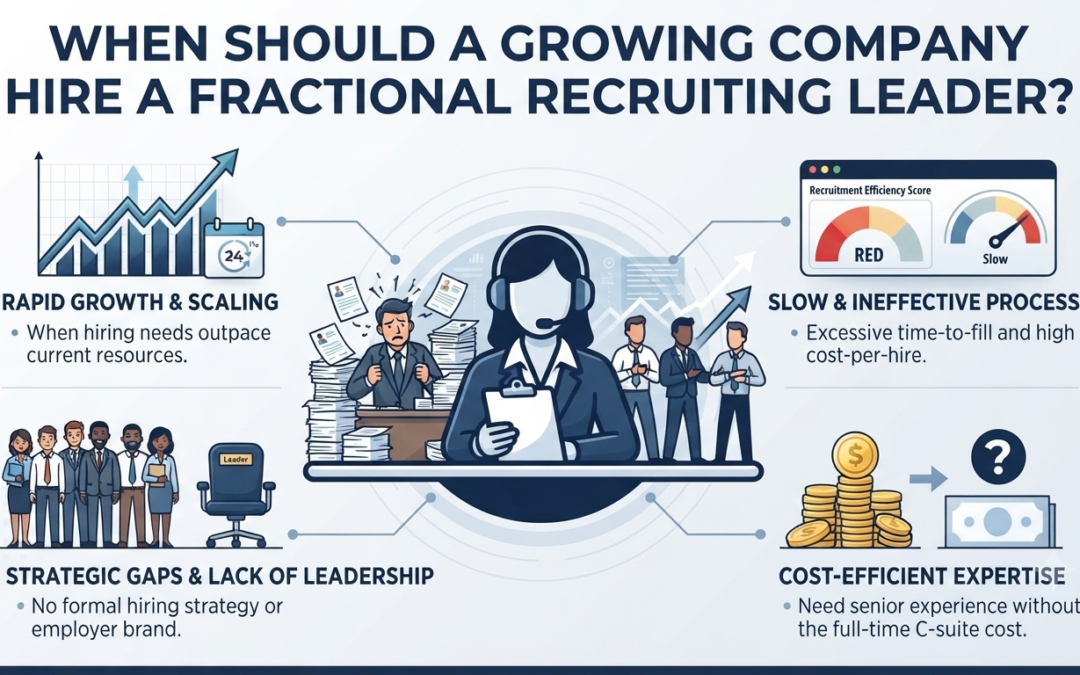
When a hiring plan doubles in a few months, recruiting often falls on managers who already have full-time jobs of their own. At that point, is it time to hire a full-time Head of Talent, or would part-time senior leadership fit this stage better?
For many growing companies, the smarter first step is a fractional recruiting leader who owns hiring for set days each week. Timing matters, because SHRM’s 2026 recruiting benchmarks put the median time-to-fill at 39 calendar days for nonexecutive roles. Time-to-fill runs from opening a role to a candidate accepting the offer, so every slow week delays your plan.
What a Fractional Recruiting Leader Does
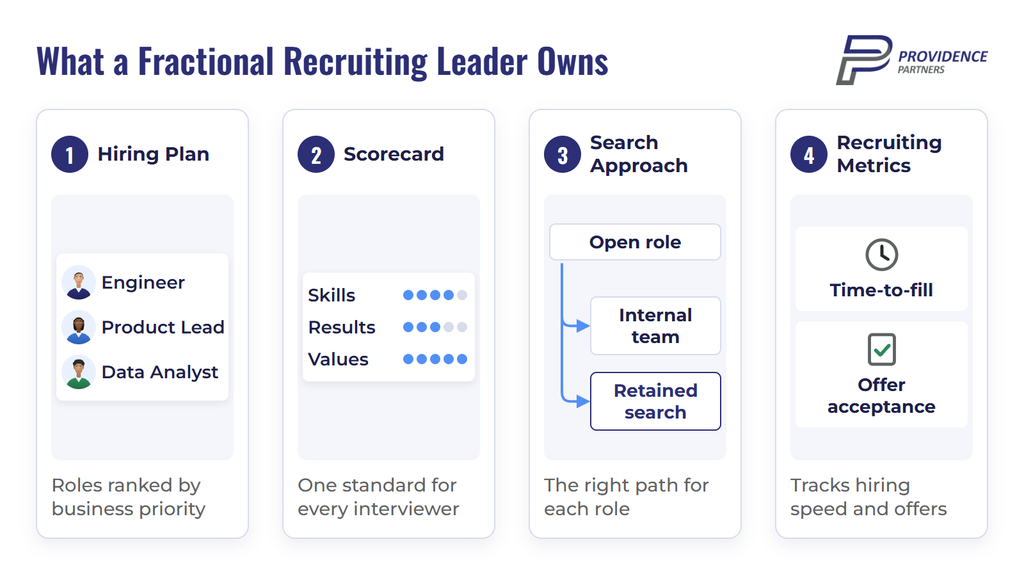
This senior talent acquisition expert leads your hiring for a set number of days each week or month. Unlike a recruiter who mainly fills open roles, this leader owns how your company finds, assesses and hires people.
The work starts with a hiring plan built with your executives and a scorecard written for each open role. A scorecard lists the skills and results that define success, so every interviewer judges candidates by one standard.
The leader also decides which roles your team can fill directly and which ones need a retained search. In a retained search, a company pays a recruiting firm an upfront fee to run one dedicated, exclusive search. Metrics such as time-to-fill and offer acceptance are tracked too, so your leadership team can see what is working.
4 Growth Moments That Call for a Fractional Recruiting Leader
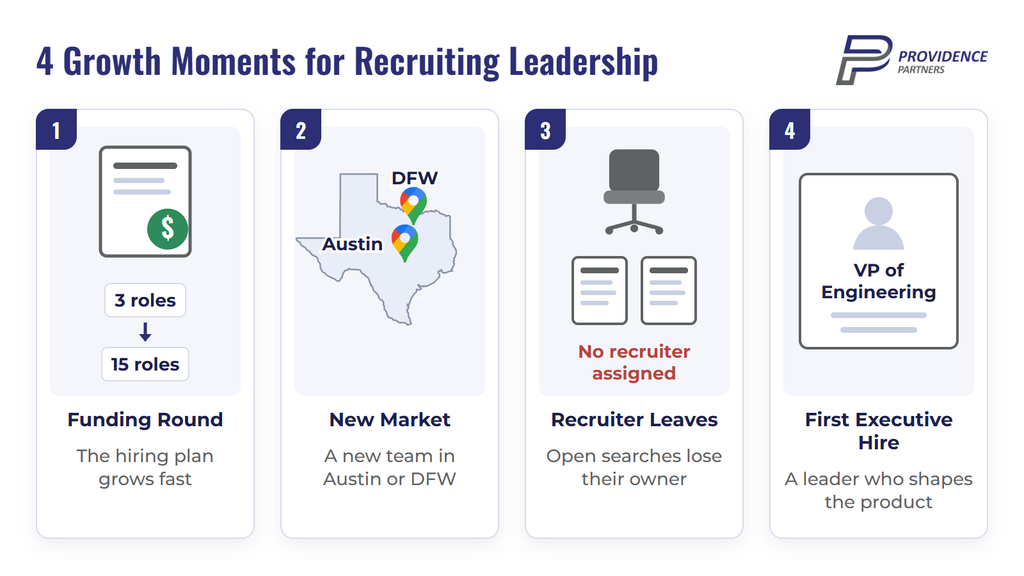
The need for recruiting leadership usually starts with a business event, well before headcount makes the gap obvious. If your company is in one of these four moments, the timing is probably right to act.
1. After a Funding Round or an Approved Hiring Plan
A funding round or an approved budget can turn three open roles into 15 within just a few months. Without one person setting the order of those hires, managers run separate searches and key roles stay open.
2. When You Build a New Team or Enter a New Market
Building an engineering group in Austin or a new team in Dallas-Fort Worth means hiring in an unfamiliar market. A fractional leader brings salary benchmarks, local hiring knowledge and proven places to find candidates from the first week.
3. When Your Only Recruiter or TA Lead Leaves
If your only recruiter or talent acquisition lead resigns, every active search can lose its owner on the same day. A fractional leader can keep those searches moving within days while you decide who should own recruiting long term.
4. Before Your First Executive or Critical Technical Hires
A company’s first VP of Engineering or senior AI engineer can shape its product and culture for many years. An executive search for a role like this needs a clear scorecard and a market check on pay first.
These are the moments when growing tech and engineering companies usually reach out to Providence Partners for help. Planning before searches turn urgent protects both your hiring budget and the timeline your board expects you to meet.
Too Early, Right Time or Too Late?
Bringing in recruiting leadership too early ties up budget, while waiting too long leaves managers recruiting instead of leading teams. The table below shows which hiring model usually fits each stage of company growth.
| Stage | What You See | Best Fit |
| Too early | 1-3 hires a year | Founder-led hiring or one agency search |
| Right time | 5+ hires planned, no recruiting owner | Fractional recruiting leader |
| Right time | New market or executive search | Fractional leader plus retained search |
| Too late | Steady year-round hiring and a recruiting team | Full-time Head of Talent |
If your company fits two rows, start with the smaller commitment and add support as your hiring workload grows. A fractional recruiting engagement is much easier to adjust than a permanent executive hire made too early.
Fractional Head of Talent vs. a Full-Time Hire: The Cost Question
A full-time Head of Talent needs a budget for salary, benefits, payroll taxes, recruiting tools and a long-term commitment. The Bureau of Labor Statistics reports that benefits made up 30.0 percent of private industry employer compensation costs in June 2026.
That figure is an average for all private industry workers, yet it shows how much benefits add to a salary. With a fractional model, you pay only for the senior leadership time your current hiring plan really needs.
As a planning example, compare one full-time leader’s yearly cost with two days a week of fractional support for six months. If you want real numbers, the Providence Partners recruiting ROI comparison lets you test your own hiring assumptions first.
What to Have Ready Before Day One
Every Providence Partners engagement moves faster when three basics are ready before the first meeting with your leaders. These items let the first weeks go into real hiring work instead of chasing missing information:
- Hiring Plan: A list of the roles you expect to open over the next two quarters, ranked by business priority.
- Pay Ranges: Approved salary bands for each role, even rough ones, so pay questions never hold up a strong offer.
- Decision-Makers: The name of the person who approves each hire, so interview feedback reaches someone who can act quickly.
What the First 90 Days Usually Look Like
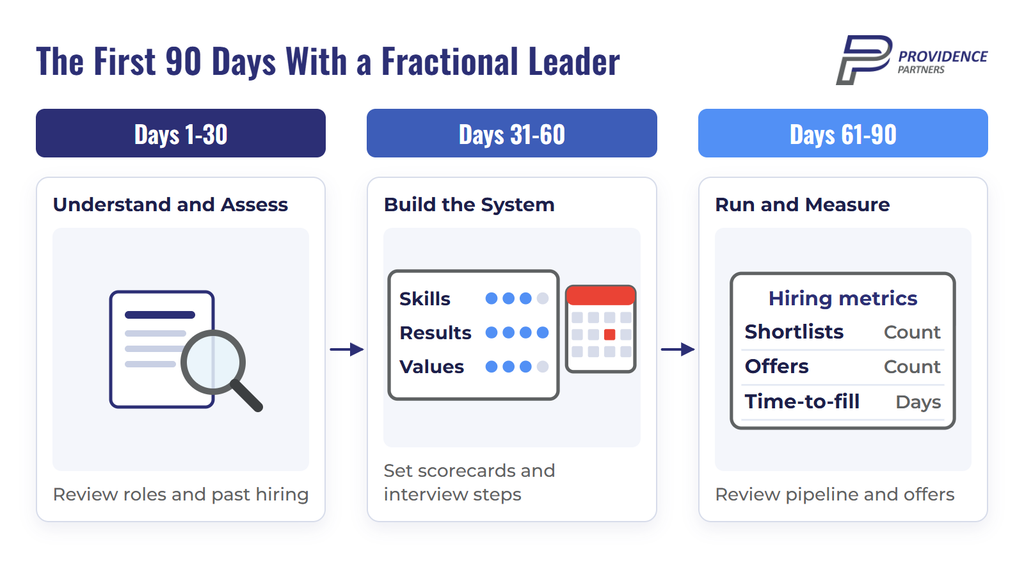
Every engagement is a little different, but the first three months usually move from learning your business to running searches. At Providence Partners, this rhythm follows the understand, assess, strategize, embed and scale stages we use with clients.
- Days 1-30, Understand and Assess: The leader learns your business goals, meets each hiring manager and reviews open roles and past results.
- Days 31-60, Build the System: Executives and hiring managers agree on scorecards, interview steps and a weekly hiring review, and priority searches begin.
- Days 61-90, Run and Measure: Searches move to shortlists and offers, while simple reports show time-to-fill and where candidates drop out.
When to Move From Fractional to a Full-Time Head of Talent
A full-time Head of Talent usually makes sense once hiring stays steady all year and several recruiters need a manager. At that stage, recruiting needs a daily owner rather than the few set days a fractional arrangement provides.
Experienced fractional leaders plan for this handoff from the start, so the hiring process they build stays with your team. The Providence Partners guide on how fractional talent acquisition supports high-growth companies explains how this support grows alongside a business.
Bring in a Fractional Recruiting Leader at the Right Moment
The best time to bring in this leader is just before your next hiring wave stretches the team too thin. If one of these growth moments matches your plans, a short conversation now can save you months of slow hiring.
With 14+ years in recruiting and 2,000+ placements, Providence Partners builds hiring systems for tech, engineering and AI and ML teams. Strong candidates rarely wait for a slow process, so book a strategy call about fractional recruiting leadership before your next hiring wave begins.
Frequently Asked Questions
1. What Is the Difference Between a Fractional Recruiter and a Fractional Recruiting Leader?
A fractional recruiter mainly sources, screens and fills open roles, working directly with your hiring managers each week. The leader owns the hiring strategy, process and results, and often runs the most critical searches personally.
2. How Many Days a Week Does a Fractional Head of Talent Work?
Most engagements begin with one to three days a week, with extra time early on to set up the process. If hiring demand rises or falls later, the schedule changes to match the work ahead.
3. Can a Fractional Recruiting Leader Work With Our Existing Recruiters?
Many Providence Partners engagements work exactly that way, with the leader adding strategy, structure and coaching to your team. Internal recruiters keep sourcing candidates and scheduling interviews, with clearer priorities guiding each week of their work.
4. How Long Does a Fractional Recruiting Engagement Usually Last?
Many companies start with three to six months to set up their hiring process and fill their most important roles. If funding cycles or expansion into a new market add more hires, the engagement often continues longer.
5. Is a Fractional Recruiting Leader Worth It for a Small Company?
A small company gets the most value when several important hires are planned and nobody owns the hiring process yet. If you only hire one or two people a year, Providence Partners may suggest a single agency or retained search instead.