


Are your open roles staying open longer than your projects can wait? Many growing companies face the same choice at this point. Should you bring in a recruitment agency or add a fractional recruiter to the team?
The U.S. Bureau of Labor Statistics reported 7.1 million job openings in August, so strong candidates still have plenty of options.
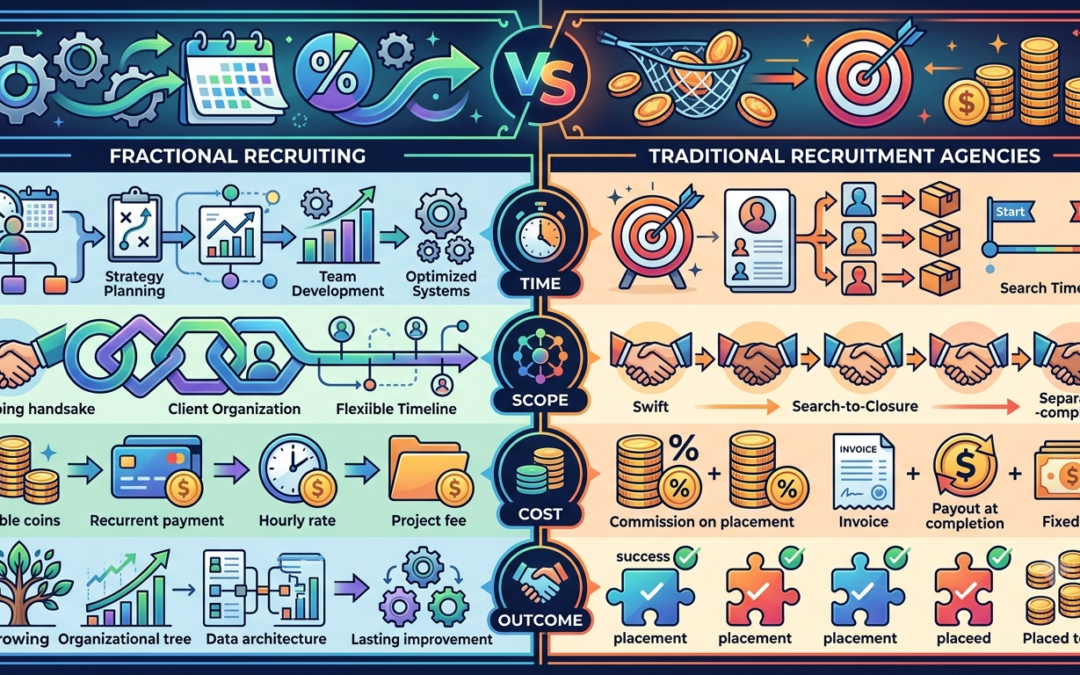
The fractional recruiting vs recruitment agency decision comes down to what you need solved. An agency finds candidates for specific roles and usually earns a fee for each placement. A fractional recruiter works inside your business for agreed hours, fills roles and also improves the way your team hires.
Providence Partners offers both models, so this guide gives you a fair view of each one. You will see how they differ on cost, control, speed and long-term value.
What Fractional Recruiting Means
Fractional recruiting gives you an experienced recruiter or talent leader for a set number of hours each week or month. They join your hiring meetings, work in your applicant tracking system (ATS) and speak to candidates as part of your team.
You usually pay an hourly rate, a monthly retainer or a project fee. Since the fee covers time and expertise, it stays the same whether the recruiter closes 2 hires or 5 in that period. That comparison assumes the same agreed scope and hours, so check what your fee includes.
The work can also include recruiting strategy, interview scorecards and hiring manager coaching. If hiring needs more direction, these tasks help your managers work from a shared plan. For a deeper look at the leadership side, see how fractional talent acquisition helps high-growth companies plan their hiring.
How Traditional Recruitment Agencies Work
A traditional recruitment agency is an outside firm that searches for candidates on your behalf. You share the job description, and the agency sources candidates from its network and job boards. Then you receive a shortlist to review and interview with your team.
Agencies work under a few common models:
- Contingency recruiting: You pay only when you hire the agency’s candidate, usually a percentage of first-year salary.
- Retained search: You pay part of the fee upfront for a dedicated search, which is common for executive and senior roles.
- Contract staffing: The agency employs the worker and bills you an hourly rate for project work or a short-term workload spike.
- Contract-to-hire: The person starts as a contractor, and you can convert them to your payroll once both sides see a good fit.
This model is still widely used. According to the American Staffing Association, nearly 2.2 million temporary and contract employees worked for America’s staffing companies during an average week in 2024.
If your team needs this kind of support, Providence Partners offers several ways to hire. Our contract staffing, direct hire recruiting and executive search services follow these proven models for tech and engineering employers.
Fractional Recruiting vs Recruitment Agency: Side-by-Side Comparison
| Factor | Fractional Recruiting | Recruitment Agency |
| How you pay | Hourly rate, monthly retainer or project fee | Placement fee or bill rate for each hire or worker |
| Where the work happens | Inside your team, tools and ATS | Outside your business, through the agency’s process |
| Main goal | Fill roles and build a hiring process that lasts | Fill a defined role or group of roles |
| Hiring manager support | Calibrates roles, coaches interviewers, tracks metrics | Mainly intake calls and candidate feedback |
| Candidate experience | Managed in your employer brand | Managed by the agency recruiter |
| What stays after | Scorecards, pipelines, data and process | The placed hire |
| Best fit | Several roles, uneven hiring demand, weak process | One clear role, niche search, short-term staff |
These are general patterns, not fixed rules. Some agencies offer deep advisory support, and some fractional engagements focus only on sourcing. So, always compare the scope written in each agreement before you choose a partner.
7 Key Differences That Shape Your Hiring Results
1. Pricing Model and Total Hiring Cost
The biggest difference is what triggers the cost. An agency usually charges per hire, while a fractional recruiter charges for time.
Here is a planning example, not a quote. Say an agency charges 20% on engineering roles that pay $130,000, which is $26,000 per hire. A fractional recruiter at $110 an hour for 30 hours a week over 20 weeks costs $66,000.
| Hires in 20 Weeks | Agency at 20% | Fractional Engagement |
| 1 | $26,000 | $66,000 |
| 2 | $52,000 | $66,000 |
| 3 | $78,000 | $66,000 |
| 5 | $130,000 | $66,000 |
For 1 or 2 hires, the agency costs less in this example. From the third hire on, the fractional model costs less, as long as the recruiter fills those roles within the agreed hours.
If you also want to compare internal recruiting costs, the Providence Partners ROI comparison tool provides a broader view. It lets you enter salaries, fees and hiring volume to compare an internal team with our recruiting model.
2. Ownership of the Hiring Process
An agency usually owns the search, while your team still owns interviews, feedback, decisions and offers. If your process is slow or unclear, more candidates will not fix it.
A fractional recruiter can own the whole flow, from the intake meeting to the accepted offer. They push for timely feedback and keep every interviewer working from the same criteria.
3. Incentives and Candidate Fit
Contingency agencies earn their fee when you hire their candidate, under the agreement’s terms. That model rewards speed, which helps when a role is urgent and the requirements are clear.
On an hourly or retainer model, a fractional recruiter earns the same fee regardless of the number of placements. As a result, they can take more time, question a weak shortlist or reopen a search when the fit is wrong.
4. Employer Brand and Candidate Experience
Candidates often meet an agency recruiter before they meet your company. The agency controls the first message, the pitch and the follow-up.
A fractional recruiter speaks to candidates as a member of your team. They use your email, your tone and your values, so those early conversations reflect your employer brand. This matters for passive candidates, who judge your culture by how you treat them in the first week.
5. Speed, Ramp-Up and Flexibility
Agencies can often start sending candidates within days, since they already have a network in place. Contract staffing can place a worker even faster for project work, depending on availability and requirements.
Fractional recruiters need a short ramp-up to learn your roles, tools and team. After that, you can raise or lower their hours as hiring demand changes, based on your contract terms.
6. Data, Candidate Ownership and What Stays After
Agency candidates usually stay in the agency’s database. If you hire a submitted candidate within the agreed period, the fee usually still applies.
With fractional recruiting, candidate records, notes and pipelines stay in your ATS. When the engagement ends, your team keeps the process, the scorecards and a warm talent pipeline for the next role.
7. Risk Protection and Accountability
Many agency agreements include a replacement guarantee. If the hire leaves within an agreed period, the agency searches again or returns part of the fee. The agreement sets the conditions, so check which remedy applies before you sign.
Fractional recruiters usually do not offer placement guarantees. Instead, you hold them to agreed goals, such as time-to-fill, offer acceptance and hiring manager satisfaction, which you review together.
When a Recruitment Agency Is the Better Choice
An agency is often the simpler option when your process already works and you only need more reach:
- One urgent or senior role: A specialist agency that knows the market can reach passive candidates faster than a new internal search.
- Niche technical skills: Roles like ASIC design or firmware engineering need recruiters who already know where that talent works.
- Short-term or project work: Contract staffing covers a product launch, a backlog or a critical deadline without adding permanent headcount.
- Testing fit first: Contract-to-hire lets both sides confirm the fit before a permanent offer.
If your next hire matches this list, Providence Partners can run the search as a traditional agency partner. Our engineering recruitment team supports permanent, contract and executive roles.
When Fractional Recruiting Makes More Sense
Fractional support helps when the problem is bigger than a single open role. Internal teams face heavy workloads, since SHRM found that extra-large organizations saw a 67% increase in median requisitions per recruiter in 2026.
This model fits well in these situations:
- Hiring several roles at once: A funding round or new contract can create many urgent searches across teams.
- No dedicated recruiter yet: Founders and engineering leads lose hours to resumes and scheduling instead of their main work.
- Inconsistent interviews: Every manager asks different questions, so strong candidates get missed because the team lacks shared criteria.
- Uneven hiring demand: You need extra capacity for a few months, but not a permanent recruiting team.
If several of these sound familiar, the signs that call for fractional recruiting support can help you decide on the next step.
Using Both Models Together
You do not always have to pick a single model for every search. Many companies use a fractional recruiter to run the hiring function and a specialist agency for a hard-to-fill search.
This works best when you write down responsibilities from the start:
- Candidate ownership: Decide who owns a candidate if both the agency and your recruiter find the same person.
- Single point of contact: Let the fractional recruiter manage agency submissions, feedback and timelines so everyone knows where to send updates.
- Clear briefs: Share the same approved job description, pay range and interview plan with everyone.
Without these rules, duplicate submissions and fee disputes can follow. At Providence Partners, a fractional leader can also manage your agency vendors, which helps you control total spend.
Questions to Ask Before Signing Either Agreement
Whichever model you choose, ask these questions before you sign:
- Daily work: Confirm who will actually do the sourcing, screening and candidate calls.
- Recruiter workload: Ask how many other searches or clients that person will handle at the same time.
- Fee coverage: Check what the fee covers and which services or tasks cost extra.
- Contract terms: Find out what guarantee, notice period or minimum term applies.
- Candidate data: Confirm who owns candidate data and how long a submission stays valid.
- Progress reviews: Agree on which metrics both teams will review and how often.
Clear answers protect your budget and your candidate experience. They also show you whether the partner understands your roles. If you want to discuss these details, the Providence Partners team will walk through each point on a strategy call.
Hiring Tech and Engineering Talent in Texas
Local market knowledge matters for both models. The Texas Workforce Commission reported that Texas added 154,300 jobs over the year to September. For employers in Austin and DFW, local recruiting knowledge helps focus searches on the engineers their projects need.
Each field also needs recruiters who understand the work behind the job title. Providence Partners recruits AI and ML talent, and our semiconductor talent solutions cover design, verification and fab roles.
If you are comparing a recruitment agency in Austin or need engineering staffing in DFW, Providence Partners can advise on the model and the search together.
Choose the Hiring Model That Fits Your Next Stage
In the fractional recruiting vs recruitment agency debate, neither model wins every time. An agency is the stronger choice for a single clear role, a niche search or short-term staff. Fractional recruiting gives you more value when you have several roles, uneven demand or a hiring process that needs structure.
Providence Partners brings 14+ years of tech and engineering recruiting, 2,000+ placements and experience with both models. So, we can recommend the right approach for each stage instead of pushing a single service.
Share your open roles, timeline and budget with the Providence Partners team. Through our fractional recruiting services, we can embed with your team, run key searches or combine both to keep your hiring on track.
FAQs
1. Is Fractional Recruiting Cheaper Than a Recruitment Agency?
It depends on how many people you hire. For 1 or 2 hires, a contingency fee can cost less. For several hires in a few months, a fixed fractional fee usually works out cheaper per hire within the agreed scope.
2. What Is the Difference Between a Fractional Recruiter and an In-House Recruiter?
An in-house recruiter is a full-time employee with salary, benefits and tools. A fractional recruiter works agreed hours on contract, so you can scale support up or down as hiring needs change.
3. Can a Fractional Recruiter Fill Technical Roles?
Yes, if they have experience with those roles. Ask for examples of past searches, such as firmware, cloud or machine learning positions, before you sign. Providence Partners recruiters focus on tech and engineering roles across Austin and DFW.
4. Do Recruitment Agencies Offer a Guarantee?
Many do, so review the guarantee before you choose an agency. Agency agreements often include a replacement period, during which the agency searches again or refunds part of the fee if the hire leaves. Check the length and conditions in your contract.
5. How Long Does a Fractional Recruiting Engagement Last?
Many engagements run for 3 to 6 months, and some continue month to month. Providence Partners agrees on the scope, hours and review dates with you before the work begins.