


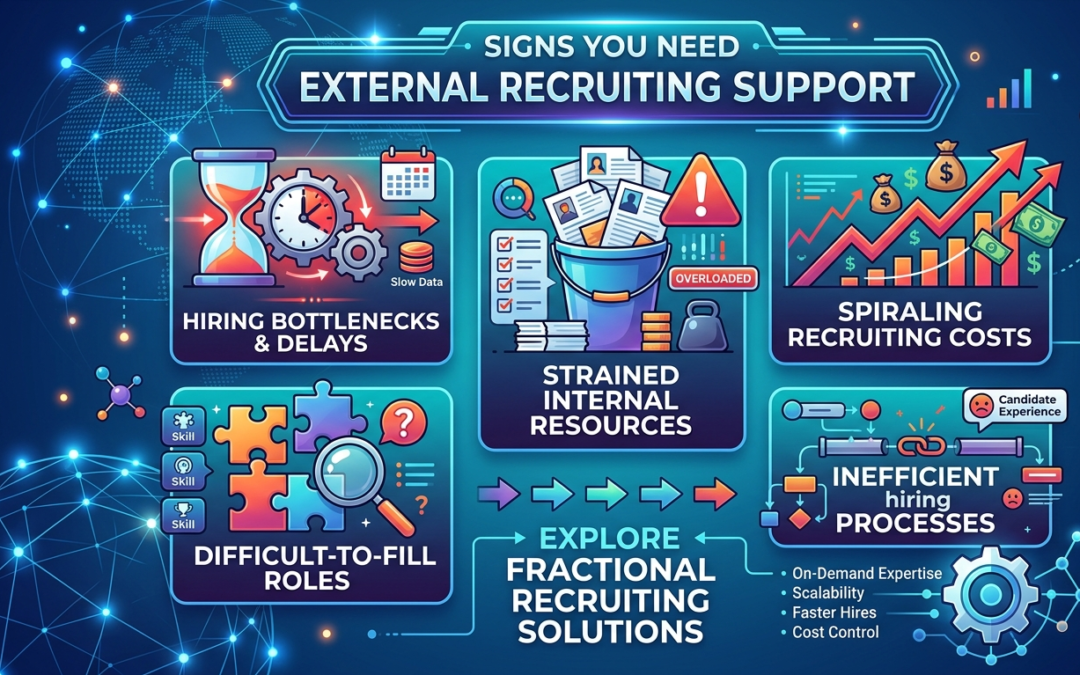
Is hiring starting to slow down the rest of your business? Fractional recruiting support gives you an experienced recruiter on a part-time or project basis, without adding a full-time salary. If your managers spend their weeks reviewing resumes while agency invoices grow, you may need help to keep each search on track.
The U.S. Bureau of Labor Statistics reported 7.3 million job openings in July 2026. Meanwhile, SHRM reports that over 2 in 3 employers struggled to fill jobs in 2026. If an open AI, semiconductor, or software role holds up your Texas team, you feel that pressure through missed deadlines.
What Is Fractional Recruiting?
Fractional recruiting brings a recruiter into your business for agreed hours or a defined project. They work with your team, use your hiring process, and can manage records in your applicant tracking system (ATS). That way, you can see who they contact and where each candidate stands.
You typically pay hourly rates or a monthly retainer, rather than a placement fee for each hire. Since fees can vary, check what the price covers before you sign.
The term can sound like hiring a part-time executive, such as a fractional CFO. Here, fractional talent acquisition can include a hands-on fractional recruiter, a fractional head of talent, or both. The recruiter handles daily hiring tasks. If you need a long-term plan too, the head of talent shapes your recruiting strategy.
What a Fractional Recruiter Handles
If you need full-cycle recruiting, the work covers each stage from defining the role to supporting the new hire. You can also agree on help with specific stages:
- Role intake: They meet your hiring managers to clarify the skills, pay range, and goals behind each job description.
- Sourcing: They use LinkedIn Recruiter and referrals to reach passive candidates who may never see your job posts.
- Screening: Through phone screens and relevant skill checks, they assess fit before your team spends time interviewing.
- Interview coordination: They arrange each round and follow up on feedback, so candidates know what happens next.
- Offer support: They help with offer negotiation and stay involved through onboarding, if your agreement includes it.
If your team also needs direction, Providence Partners provides Talent Acquisition leadership through our fractional recruiting services. We connect workforce planning with AI-enabled recruiting to guide how your team hires. This keeps the work focused on the roles you need most.
5 Signs Your Company Needs Fractional Recruiting Support
You may recognize 1 of these issues before the others appear. If several happen at once, review who owns hiring and how much time they can give it.
1. Managers Spend Too Much Time on Recruiting
If nobody owns recruiting, founders and department heads fit it around the work they already need to do. Your engineering lead may review resumes after a client call, then miss a candidate’s reply during a product meeting.
If replies take too long, they hurt the candidate experience. They can also hurt your employer brand if people feel that nobody values their time.
Look for these signs in your team:
- Your CTO spends hours reviewing resumes, leaving less time for product decisions that need their input.
- Candidates wait days for feedback, and some accept another offer before you respond.
- Your team cannot see each candidate’s next step, so promising applicants lose contact with you.
A recruiter gives that work a clear owner. Your managers still make hiring decisions, but they get the information they need without chasing every update.
2. Hard-to-Fill Roles Stay Open for Months
SHRM’s 2026 benchmark puts median time-to-fill at 39 calendar days for nonexecutive roles. That gives you a useful point of reference. Still, some tech roles will take longer to fill.
If a machine learning or firmware role stays open for a full quarter, look at why people drop out. The pay range, job requirements, work location, or slow interviews may need attention. Posting the same job again will not fix those issues.
For hard-to-fill roles, active sourcing helps you reach people beyond current applicants. A recruiter builds a candidate pipeline and explains why the role may suit each person. This gives your team more people with the right skills to assess.
That search also benefits from contacts in your field. Providence Partners has made 2,000+ placements across tech and engineering. Our work with AI and ML talent and semiconductor specialists helps us understand the skills behind a technical job title.
3. Hiring Volume Rises and Falls
A funding round can turn a quiet hiring plan into several urgent searches. Once those roles close, however, you may need far fewer recruiting hours.
If that pattern matches your business, a full-time recruiting role may be hard to justify. Cutting the role during quiet months can also mean rebuilding support when hiring returns. Fractional support lets you scale hours up or down as hiring volume changes, based on the terms you agree on.
It can fit several situations:
- Post-funding hiring: After a Seed or Series A round, you need a clear order for new hires. Once access and role details are ready, sourcing can begin.
- Hiring sprints: If a product launch or new contract has a fixed start date, a recruiter can help keep interviews on track.
- Bridge support: If your HR lead leaves or takes leave, a recruiter can keep open searches moving during the gap.
Agree on hours and notice periods upfront, so your support can change while keeping each search on track.
4. Agency Fees Take Up More of the Hiring Budget
If you use contingency agencies for several hires, each placement adds another fee. To see the effect, compare a 15% to 25% fee against each new hire’s first-year salary. Your actual rate depends on the agency agreement.
Consider an Austin software company hiring 6 engineers at $140,000 each after its Series A. At a 20% fee, agency charges total $168,000. By comparison, 20 hours a week at $125 an hour for 16 weeks totals $40,000 in fractional recruiter fees.
These figures show the fees, but they do not promise 6 hires. The recruiter may need more time to fill all 6 roles, and tools or other costs may add to the budget.
For broader context, SHRM reported average cost-per-hire of $5,475 for nonexecutive roles and $35,879 for executives in 2025. Those figures cover hiring costs across the employers in the study, not just agency fees.
You should also weigh what your team gains beyond each hire. Providence Partners focuses on long-term outcomes, so we help you fill roles and improve how your team hires. That gives your team more lasting support than one-off placements alone.
5. Hiring Decisions Lack a Consistent Process
If every manager interviews differently, it becomes harder to compare people fairly. Without interview scorecards, your team may favor a confident speaker over someone with stronger job skills. That can raise the risk of bad hires.
A fractional recruiter can help you set up structured interviews. With clear questions and a fair scoring guide, your team can focus on job skills. Each person on your hiring team then knows what to assess and how to explain their choice.
They can also track recruiting metrics, including where candidates drop out and how long each stage takes. If offers keep falling through, for example, you can review pay and feedback instead of guessing. This hiring infrastructure stays with your team, so you can keep using the process once the work ends.
Fractional Recruiting vs. Other Hiring Models
Start with the work you need covered, then compare the cost and length of support.
| Factor | Fractional Recruiting | Contingency Agency | RPO | In-House Recruiter |
| How you pay | Hourly rates or monthly retainer | Salary-based placement fee; compare 15%-25% | Per-hire, project, or monthly fees | Salary, benefits, and tools |
| Commitment | May be month-to-month or per project | Per search | Defined project or longer contract | Permanent headcount |
| Best fit | Changing needs and specialist support | Individual searches | Broader hiring delivery or high-volume hiring | Steady hiring throughout the year |
If you need 10 or more hires a month, compare recruitment process outsourcing (RPO) with fractional and internal support. That number alone does not decide the best fit. Role difficulty and your team’s capacity matter too. An in-house recruiter may suit steady demand, while project RPO can cover a defined hiring push.
Because your needs can change, Providence Partners also offers contract staffing, direct hire, and executive search. We can discuss those options alongside fractional support to match the work ahead.
What Does Fractional Recruiting Cost?
The price depends on the roles, the scope, and the skills the recruiter brings. When you compare quotes, look at how each fee works:
- Hourly rates: As a planning example, compare $75 to $150 per hour, with a $250 rate for specialist support. These figures help you test a budget. They are not a Providence Partners quote or a fixed market range.
- Monthly retainer: A fixed fee covers agreed hours or services. This keeps costs predictable if you also agree on fees for extra work.
- Project-based fees: You agree on a price for a defined hiring project, including what the recruiter will deliver and when.
For salary context, the Bureau of Labor Statistics reports a $75,940 median annual wage for human resources specialists in May 2025. This group includes other HR roles as well as recruiters. Benefits, taxes, and software can bring the full employment cost above $100,000, based on the job and what you offer.
If you only need support for part of the year, compare the full project cost with what you would spend on a full-time hire.
How to Choose a Fractional Recruiting Partner
A good recruiter should explain how they plan to fill the roles you have open. If you plan to hire a fractional recruiting partner, cover these points first:
- Niche experience: Look for proof of past work on roles like yours, such as FPGA design, cloud security, or fintech compliance. They should understand the skills your team needs.
- Data ownership: Confirm which candidate records stay in your ATS, what you can export, and which tools you can still use when the work ends.
- Local market insight: Discuss salary ranges, work location, and competing offers, so you know what a strong offer needs to include.
For Texas employers, those local details can shape who responds to an offer. Providence Partners supports tech recruiting in Austin and engineering staffing in DFW. Because we work in semiconductor and software hiring, we can use that local knowledge to guide your search.
Build a Stronger Hiring Process With Fractional Support
If managers keep chasing candidates or key roles delay projects, your team needs a clear owner for hiring. Fractional recruiting can give you that support. It also helps you plan costs and build a process your team can keep using.
Providence Partners brings 14+ years of experience and relationships with 50+ partner companies. Share your open roles, timelines, and budget so we can discuss how a fractional recruiting partner could fit your team. Call 512-750-0778 to speak with our recruiting leaders.
FAQs
1. What Does a Fractional Recruiter Do?
They handle agreed hiring tasks, such as sourcing, screening, interviews, and offers. As they work with your team, they can also improve how you hire and keep records up to date.
2. How Much Does Fractional Recruiting Cost?
You may pay by the hour, monthly retainer, or project. Compare quotes against your hiring plan, using $75 to $150 per hour to test your budget. Senior support may cost more, so weigh the fee against the work you need and the results.
3. What Is the Difference Between Fractional Recruiting and RPO?
RPO transfers all or part of recruiting delivery to an outside provider, through a project or longer agreement. Fractional support typically adds a recruiter or talent leader for agreed hours. Some contracts run month-to-month, but always check the terms.
4. How Many Hours a Week Does a Fractional Recruiter Work?
Light support might need 10 hours a week, while a hiring push could need 20 to 40 hours. If you need those hours every week for the long term, compare other models too. Providence Partners can discuss the scope that fits your open roles.
5. Is Fractional Recruiting Good for Startups?
Yes, if you need hiring expertise before your workload supports a full-time recruiter. A fractional partner can help hire key people and set up a process you can use as you grow. Providence Partners supports startups and tech companies across Austin, Dallas, and Fort Worth.