


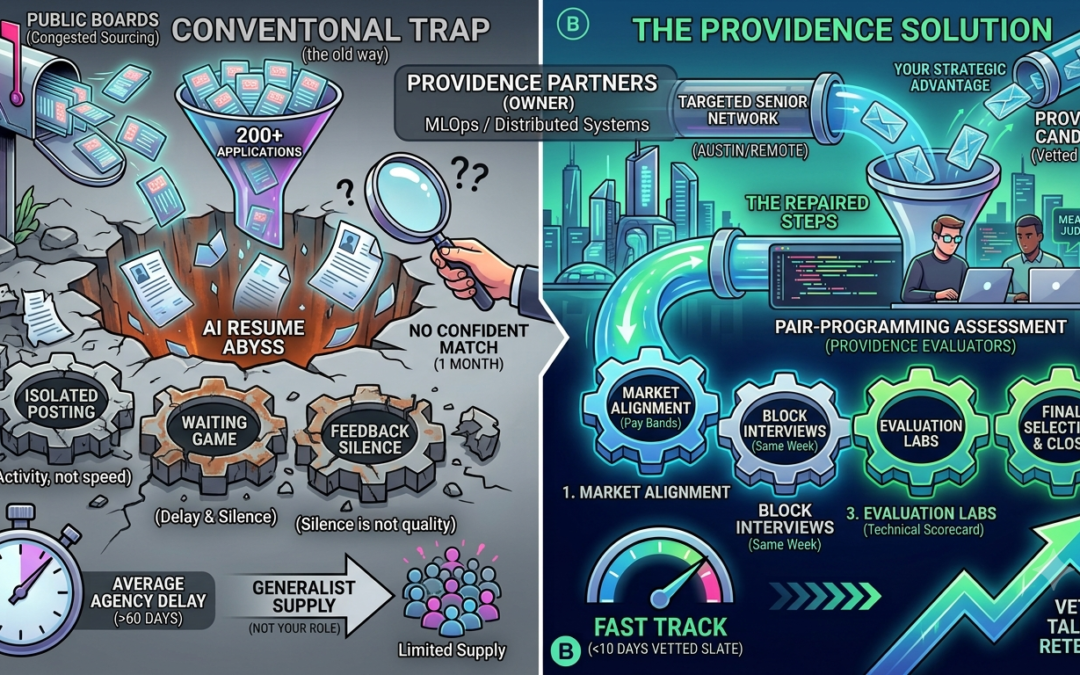
Open a software req today and you may receive 200 applications in one week. Then, a month later, you still have no one you would confidently introduce to your hiring manager.
That gap explains the real software hiring challenges in 2026. The problem is not a lack of activity. It is a hiring process that creates volume but fails to identify, engage, and close the right people.
For most employers, the biggest recruitment challenges come from five places: a senior-level talent shortage, slow hiring processes, resumes that no longer prove real ability, rising salary expectations, and counteroffers that arrive before your offer does.
Demand still has weight behind it. The Bureau of Labor Statistics projects 15% growth for software developers, quality assurance analysts, and testers from 2024 to 2034, with about 129,200 openings each year. Hiring software developers will not get easier by posting more often. You need to repair the steps between the job posting and the signed offer.
Why Technical Hiring Feels Different
A job title does not tell you what a person can truly build. Two software engineers may list the same tech stacks, yet one can manage production incidents, architecture decisions, and code review without help while the other cannot.
That is why evaluating technical skills takes more than scanning a resume. It also explains why a weak job description creates expensive problems. If your job description describes a role your team no longer needs, the wrong people apply and qualified candidates move on.
The market also includes a large group of passive candidates. They already have jobs, know their value, and rarely spend time on job boards. Your outreach must give them a real reason to listen. This is where tech recruitment becomes relationship work, not just application sorting.
There is another pressure point: tech evolves faster than your job postings. A role written eight months ago may not reflect your current tools, architecture, or customer needs. That widening skills gap makes an old hiring plan fail before interview scheduling even begins.
The Talent Shortage Is Not Everywhere
The talent shortage is real, but it is not a flat shortage across every experience level. You do not lack resumes. You lack production engineers who can make good decisions when the work gets hard.
Junior and generalist supply has grown, while many teams still need senior developers who can own systems, guide a team, and take AI into production safely. That is where the limited talent pool becomes obvious.
The difficulty in finding specialized skills gets sharper in niche IT roles. MLOps, distributed systems, security, embedded engineering, and specialized skills in AI infrastructure do not appear in every local market. A senior engineer with the right background may have four employers calling them at once.
CompTIA reports a meaningful replacement rate for tech occupations, which matters because retirement and job movement take institutional knowledge out of teams every year. Your local talent may not close a senior req by itself. Geographic constraints make the search even harder when a company will not consider remote, hybrid, or relocation options.
The practical move is to expand your talent pool before the role becomes urgent. Build talent pipelines with people you may need later, not only when a manager says they need someone next week.
Providence Partners focuses on this senior market through our engineering talent network. When a role has stayed open for more than 60 days, the issue is often reach, not effort.
Slow Hiring Processes Lose Good People
Slow hiring processes cost teams more than time. They cost them their best candidates.
Top candidates can leave the market in roughly 10 days. Yet many hiring cycles for software engineers run beyond 60 days, and senior roles can take three to six months. That is not a quality problem. It is time-consuming recruitment competing against a market that already moved on.
Long interview rounds, slow feedback, and hiring manager delays create candidate dropouts. Candidates do not see silence as careful hiring. They see a company that may also move slowly after they join.
You can compress the timeline without lowering the bar:
- Keep the hiring process to three meaningful stages, not five repetitive calls.
- Confirm the salary range before the first serious interview.
- Give hiring teams a standing weekly interview block so interview scheduling does not wait for calendar gaps.
- Require same-day interview feedback where possible.
- Track time-to-fill, time-to-hire, offer acceptance rate, and candidate drop-off together.
These metrics tell one story. If time-to-fill improves but offer acceptance rate falls, you have not fixed the process. You have simply moved the problem.
Every open technical hiring need also has a business cost. Projects slow down, current employees absorb more work, and your next hire becomes harder to attract because the team already feels stretched.
Resumes No Longer Prove the Work
AI-generated applications have changed the hiring funnel. Resume overload does not mean your applicant tracking systems are working well. It often means the systems are receiving polished profiles that do not reflect real experience.
AI resume screening can make this worse. AI-driven candidate screening inaccuracy may reject someone over a keyword mismatch while passing a machine-written resume that matches every phrase in your search.
That is why we need to test for what AI cannot do.
The 2025 Stack Overflow survey found that more developers distrust AI output accuracy than trust it. Experienced developers show the most caution. They know an answer can look right, compile correctly, and still fail in production.
Use skills-based screening that measures judgment, not just syntax:
- Create practical assessments around work your team actually does.
- Use pair-programming sessions so you can hear how candidates reason through a problem.
- Run technical interviews that include debugging, tradeoff decisions, and code review.
- Show candidates AI-written code and ask them to identify what is wrong.
- Use structured interviews and score behavioral interview questions against the same rubric to reduce bias in evaluation.
A model can generate code quickly. It cannot reliably explain why a design choice will hurt performance, security, reliability, or future maintenance. That is where technical screening must go deeper.
At Providence Partners, our Technical Evaluation Labs test real production thinking. Candidates may troubleshoot distributed ML systems, optimize inference engines, or debug training pipelines. Our AI/ML talent acquisition work covers 137 specialized roles, helping us separate a fluent resume from an engineer who can perform on day one.
Salary Demands Move Faster Than Pay Bands
Rising salary expectations are not only a negotiation issue. They are an information issue.
Candidates compare salary demands against a national market. Many employers still compare them against last year’s pay bands. The Bureau of Labor Statistics lists the 2024 median annual wage for software developers at $133,080, but senior compensation can rise far beyond that once benefits, equity, and local competition enter the picture.
Counteroffers add pressure. A candidate who spent weeks in your process can receive a retention package from their current employer in one afternoon. You will not win every case, and that is fine. You can avoid wasting time by setting competitive compensation packages early and explaining the full value of the role.
Strong non-salary differentiators matter here:
- Clear ownership and a visible path to impact.
- Modern tools and realistic engineering priorities.
- A manager who can explain growth, not just tasks.
- A role with enough support to succeed.
A strong offer begins before the offer letter. It begins with an honest salary range, a clear role, and a process that respects the candidate’s time.
Cultural Fit Should Not Mean Hiring the Same Person Again
Speed and quality must work together. Move too fast, and you risk early attrition. Move too slowly, and you lose the person you wanted.
The cost of a bad hire in senior software roles can reach six figures after onboarding, rework, lost delivery time, and strain on the existing team. Retention issues after hiring often come from weak management, outdated tech stacks, or no path for growth. Raw skill is only one part of the answer.
Screening for cultural and technical fit does not mean choosing people who think, speak, or work exactly like your current team. Real cultural fit means shared standards: how they handle feedback, make decisions, own mistakes, and work with others.
Use structured interviews to assess these areas fairly. It gives hiring teams a shared language and keeps personal preference from driving the decision.
Where Developers Actually Pay Attention
Developer distrust of recruiters is understandable. Generic messages, vague job descriptions, and unrealistic job requirements have trained strong people to ignore outreach.
Job boards can support hiring volume, especially for junior and generalist roles. They rarely provide enough passive senior talent for a difficult search. You need more than one sourcing channel.
A better sourcing mix includes:
- Developer communities such as GitHub and Stack Overflow.
- Employee referral programs that reward high-quality introductions.
- Specialist networks built through long-term recruiter relationships.
- Talent pipelines created before a role opens.
- Job descriptions developers actually read because they explain the work, tools, team, and salary range.
Employer branding also matters. A strong employer brand does quiet work before a recruiter sends the first message. It gives tech candidates a reason to believe your team offers something different.
Do not keep searching for unicorn candidates with a list of 20 must-have skills. That approach filters out people who could succeed and leaves important roles open for six to 12 months.
Your Three Realistic Hiring Routes
| Route | Typical time-to-fill | Passive senior reach | Best fit |
| Post and wait | 60 to 95+ days | Very low | Junior or generalist roles |
| Internal recruiter | 45 to 70 days | Moderate | Steady hiring volume |
| Specialized recruitment partner | 20 to 45 days | High | Senior, niche, and urgent roles |
Most companies do not need all three routes for every role. They need to use the right route for the actual need. A recruitment partner or staffing partner can add speed when your internal team needs passive reach, niche skills, or a stronger local read.
What Austin and DFW Employers Face
Austin and DFW do not behave like a generic national market. High competition among IT employers affects every serious senior search.
Austin employers compete with relocated headquarters, semiconductor expansion, and fast-growing product teams. DFW employers compete across aerospace, MedTech, enterprise software, and hardware. The same candidate may have choices across several industries before your hiring manager reviews their resume.
If you are looking for an IT recruitment agency in Austin after two stalled reqs, the problem may be market-specific. Our tech recruitment in Austin team works daily across silicon hardware, ASIC/RTL, and embedded hiring. Our engineering staffing across DFW work supports semiconductor, MedTech, and aerospace teams across North Texas.
With 14+ years in semiconductor and SaaS and IT, Providence Partners brings local insight that sourcing technology alone cannot provide.
Stop Letting a Slow Process Decide the Outcome
The central issue behind software hiring challenges is simple. The market moves in days while many companies still move in weeks.
You cannot out-post a talent shortage. You cannot solve AI-generated applications with the same funnel that allowed them through. But you can identify roles that need senior reach, strengthen your technical hiring process, and work with people who already know the market.
Providence Partners is a specialized IT recruitment agency in Austin that supports contract staffing, direct hire, and executive search based on how your team needs to grow.
If your role has stayed open longer than it should, call Providence Partners at 512-750-0778 or reach our Cedar Park team for a direct view of what your req is up against.
Frequently Asked Questions
1. Why is it so hard to hire software developers in 2026?
Demand continues to outpace the supply of senior developers. The shortage sits mainly at the production-ready level, not across every experience level. Teams need people who can own difficult work, and those people have more choices.
2. How long does it take to hire a software engineer?
Many software roles take more than 60 days. Senior and specialized positions can take three to six months, while strong candidates may leave the market in around 10 days. Faster decisions and clearer interview stages make a real difference.
3. What should you test for now that AI writes code?
Test judgment, debugging, system thinking, and code review. Use practical assessments, pair-programming sessions, and technical interviews that show how someone thinks through a real problem.
4. Is a tech recruiting agency worth the fee?
For junior or generalist roles, your internal process may be enough. For senior, urgent, or niche IT roles, a tech recruiting agency can help you reach passive candidates and avoid the delivery cost of a long vacancy.
5. What are the most common software hiring challenges for small teams?
Small teams face the same issues with less room for error: limited budgets, slower interview scheduling, salary competition, and weaker access to a specialist talent pool. Start with speed, clear pay bands, and a realistic job description.